1. Sudden Water Bill Spikes (The Primary Red Flag of Pressurized Loss)
One of the earliest and most unmistakable signs of an invisible plumbing leak is an inexplicable surge in your municipal water utility statement. New Jersey homeowners receiving quarterly or monthly invoices from New Jersey American Water, Suez/Veolia, Trenton Water Works, or municipal utility authorities often observe water usage doubling or tripling without any change in family occupancy, lawn irrigation, or appliance habits.
Pressurized domestic water lines operate continuously between 50 and 75 PSI. A pinhole fissure as small as 1/16th of an inch can silently discharge over 800 to 1,000 gallons of potable water every 24 hours into wall chases, foundation gravel, or lawn subsoil. If your water bill shows an unexpected spike, immediate non-invasive diagnostics can isolate whether the loss stems from an interior line or a buried exterior lateral.
2. The Municipal Water Meter Test (Definitive Home Verification)
Before scheduling an on-site specialist, you can verify whether water is escaping from your pressurized plumbing system by performing the municipal water meter isolation test:
- Ensure every fixture inside and outside the home is turned off—including sinks, showers, washing machines, humidifiers, and automatic refrigerator ice makers. Instruct all occupants not to flush toilets during the test.
- Locate your water meter, typically situated in the basement along the front foundation wall or in an outdoor ground pit box near the street curb.
- Examine the low-flow indicator dial. On mechanical meters, this is a small red triangle, blue star, or silver sweep hand; on modern digital smart meters, it is a flow indicator arrow or flashing gallon-rate icon.
- If the low-flow dial or digital rate increments while every fixture is shut off, pressurized water is actively escaping somewhere between the municipal curb shutoff and your fixtures.
3. Unexplained Warm Areas on Hard Flooring
In properties built on concrete slab foundations—common in suburban New Jersey developments and split-level homes—walking barefoot across ceramic tile, hardwood, or luxury vinyl plank can reveal localized hot spots. When a hot water domestic supply line ruptures under structural concrete, thermal energy radiates upward, heating the floor surface. If a hallway or kitchen floor feels noticeably warm without active radiant heat, an under-slab hot line leak is likely present.
4. Continuous Hissing or Faint Rushing Sound
Water under municipal pressure rushing through a hairline pipe defect creates characteristic acoustic vibrations. When ambient household noise subsides late in the evening or early in the morning, homeowners often report hearing a continuous hissing, whistling, or running water sound near baseboards, vanity cabinets, or behind laundry room walls. If the sound persists when no plumbing appliances are operating, pressurized water is escaping.
5. Drywall Discoloration, Bubbling Paint & Warped Baseboards
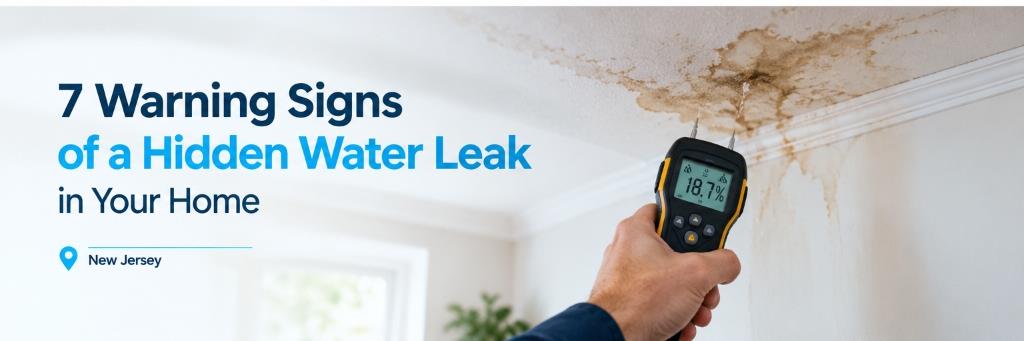
Because drywall and gypsum board act like high-density sponges, water escaping inside wall studs travels downward and wicks outward through capillary suction. Warning signs include yellowish or brownish ceiling rings, peeling latex paint, swollen MDF baseboards detaching from wall surfaces, and soft, spongy plasterboard. These visible symptoms often appear several feet away from the actual pipe rupture as water follows gravity along horizontal framing members.
6. Persistent Musty Odors & Unexplained Humidity
Concealed moisture trapped within dark, unventilated wall cavities or below subflooring creates an optimal breeding ground for mold and mildew spores within 24 to 48 hours. If you detect an earthy, persistent musty smell in a bathroom hallway, basement closet, or finished lower level that air fresheners fail to eliminate, water is almost certainly accumulating behind structural surfaces.
7. Reduced Water Pressure Across Multiple Fixtures
When an underground main water service line or secondary supply trunk develops a significant rupture, the escaping volume reduces available dynamic water pressure throughout the entire property. If opening a bathroom sink faucet noticeably starves an adjacent shower, or if household water volume drops precipitously without municipal utility maintenance, a major pipe break is losing volume before reaching points of use.
Non-Invasive Electronic Diagnostics vs. Blind Demolition
When warning signs or water bill spikes appear, cutting holes in drywall or jackhammering flooring based on guesswork causes costly, unnecessary damage. Our New Jersey diagnostic specialists utilize calibrated ultrasonic listening devices, radiometric FLIR infrared thermography, and electronic moisture mapping to pinpoint the exact location of the defect. Once marked, you receive an objective report to hand directly to your licensed plumbing contractor for surgical, minimal-impact repair.